Original article: A longitudinal analysis of judgement approaches to sustainability paradoxes by Dr Susann Power, Prof MariaLaura Di Domenico and Prof Graham Miller.
Cite: Power, S., Di Domenico, M., & Miller, G. (2024). A longitudinal analysis of judgement approaches to sustainability paradoxes. Tourism Management, 102, 104877.
Research in Plain Language:
In 2010, I found myself in a slightly surreal situation: sitting in my very own private pool, just outside my own private guest villa, in a five-star luxury eco-resort. This was not a typical setting for a twenty-something young professional. I wasn’t there on holiday, I was there on business, tasked with investigating the eco-credentials of a luxury hotel.
To be absolutely fair, those credentials were impressive. The resort’s commitment to sustainable best practices was outstanding. And yet, something didn’t sit right with me. A private swimming pool in the middle of the desert; an area marked by extreme water scarcity and deep water inequity, felt profoundly unsettling.
At the time, I didn’t realise that this moment would become a turning point. That experience quietly set me on the path away from industry, into academia, and towards a research career focused on sustainability dilemmas, especially those embedded within travel and tourism. What seemed like a benign luxury encounter became the seed of a long-standing inquiry into the sense, and non-sense, of sustainability paradoxes.

Studying Sustainability Leadership in Practice
Over the following eight years, my co-authors and I followed and engaged with tourism professionals who had been globally recognised for their sustainability leadership. These were not token gestures or greenwashing exercises; these individuals were widely seen as leading the charge in making tourism more responsible.
Through sustained, longitudinal engagement, they offered deep and often candid insights into the paradoxical realities of running tourism businesses. On the one hand, they were striving to operate commercially viable organisations. On the other hand, they were trying to do so in ways that were ethically grounded and environmentally responsible. It was in this space between aspiration and constraint that three core dilemmas repeatedly emerged.
Three Persistent Paradoxes in Tourism Sustainability
1. Can tourism ever be truly sustainable if we continue to fly?
At the heart of tourism lies movement: people travelling from home to elsewhere. Yet travel and tourism account for approximately 7.3% of global greenhouse gas emissions, a sizeable footprint by any measure. Aviation is central to this problem.
2. Is sustainability compromised by the need to deliver “good” customer experiences?
Tourism is fundamentally about pleasure, leisure, and escape. Travellers want to enjoy themselves, not feel morally chastised for their resource use. So how can tourism businesses strike a balance between fun and planetary responsibility?
3. If perpetual tourism growth isn’t sustainable, how do we honour everyone’s right to travel?
We live on a planet with finite resources, yet tourism continues to grow. International tourist arrivals increased by 4% to reach 1.52 billion people travelling globally in 2025. Many destinations are now buckling under the strain of overtourism. Should, or even can everyone travel?
These dilemmas led us to a simple but profound question: How do tourism executives navigate sustainability paradoxes in a time of unprecedented environmental and social change?
Why This Research Matters
Our research advances the conceptual understanding of Paradox Theory within the context of sustainable tourism. It contributes to literature at the intersection of tourism management, ethics, and sustainability by demonstrating the importance of time, i.e. how reflections, justifications, and moral reasoning evolve rather than remain static.
Much existing paradox research captures snapshots: moments frozen in time. By contrast, our longitudinal approach offers insight into how leaders’ thinking shifts as tensions persist, intensify, or re-emerge. Methodologically, this provides a stimulus for more long-term research in tourism management; something the field currently lacks.
From a practical perspective, our findings carry significant implications for sustainability leadership and business ethics. Tourism managers regularly confront complex challenges involving competing stakeholder interests and uncertain outcomes. This research can support both practitioners and educators by providing a framework for reflection and ethical decision-making in the face of unresolved tensions.
What We Learned: Moral Reasoning in Action
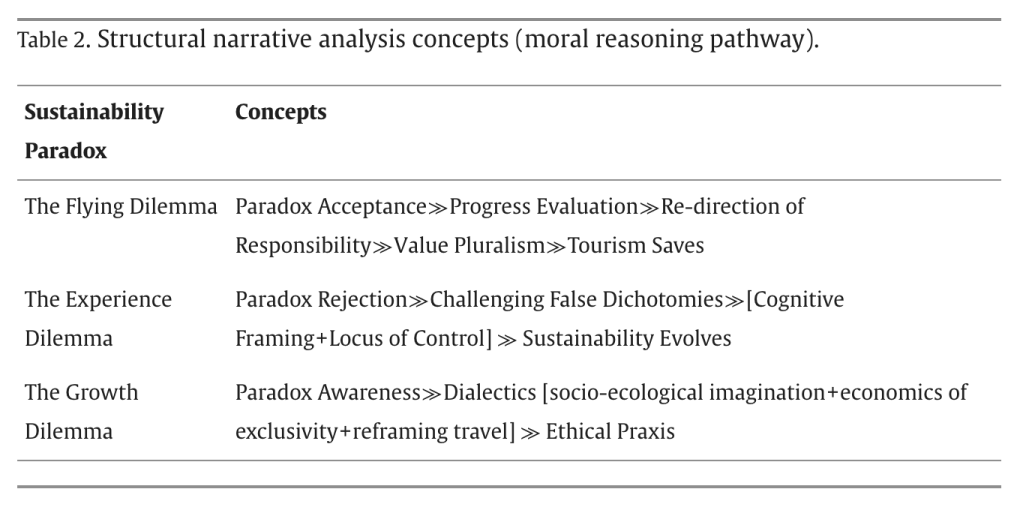
The carbon paradox
When discussing aviation and emissions, executives were surprisingly consistent. Yes, flying is a problem, but look at technological progress. Aircraft are becoming more efficient. And, importantly, many argued that how people travel is not their responsibility. Their responsibility lies “on the ground.” They also emphasised tourism’s broader benefits: job creation, livelihoods, and biodiversity protection. The core argument was clear: tourism saves. In many regions, a sudden halt to travel would be economically, socially and environmentally devastating.
Pleasure versus sustainability
Interestingly, our participants rejected the idea that sustainability and pleasure are in conflict. This, they argued, is a false dichotomy. Sustainability does not have to diminish enjoyment; it depends on how experiences are designed and framed. They also noted that public understanding of sustainability has evolved. Sustainability itself is not static. With intelligent experience design, it is possible to deliver excellent guest experiences that are also responsible.
Growth, rights, and limits
The most ambivalent discussions centred on growth. Overtourism was acknowledged, but typically framed as a management problem rather than a capacity issue. There is no tourism overshoot, some argued, if destinations are properly managed. Debate intensified around whether travel constitutes a human right. These conversations required participants to imagine alternative tourism futures and confront the consequences of unbounded growth. Ultimately, ethics and careful resource management were positioned as the pathway forward.
So, What Does This Mean?
Our research highlights the importance of explicitly recognising the contradictions that sit at the core of tourism. Even as awareness and empathy grow, paradoxes persist. In some cases, they are perceived as fundamentally unresolvable, particularly when addressing them feels like an existential threat to the industry itself. Where moral consensus proves elusive, there is a real risk in not engaging with these tensions. The longer tourism fails to meaningfully address sustainability paradoxes, the more likely it becomes that solutions are imposed externally through regulation or shifting public opinion.
It is important to note that our respondents were deliberately selected as sustainability champions. They are not representative of the entire industry. However, they offer invaluable insight into how thought leaders perceive the challenges facing tourism as a whole, and the potential role they can play in influencing wider change.
This research can guide reflective practice, stimulate debate, and support the development of what we call a “tourism imaginative” approach: one that grapples with complexity, listens empathetically to divergent stakeholder perspectives, and accepts that unresolved tensions are not signs of failure but realities to be engaged with.
You can read the full paper here:
 Susann Power
You must be logged in to post a comment.