Sometimes, as academics, our work takes us into unexpected spaces, both intellectually and geographically. One such moment arrived when I agreed to become a Human Book at a Human Library event on Rathlin Island. The gathering was hosted by the Rathlin Development and Community Association and the Ulster University Rathlin-Research Forum as part of the Northern Ireland Science Festival, and woven into the Future Island–Island research project I’ve been working on for the past two and a half years.
Under the familiar academic banner of knowledge exchange, we met in the charming Manor House hotel on Rathlin Island to explore what it means to share our stories. Take two Rathlin Islanders, one Ulster University researcher, multiply by five, and you’ve created a living, breathing Human Library.
The Human Library: A Different Kind of Collection
The Human Library concept began in Denmark as a way to spark conversations that challenge preconceptions, assumptions, and prejudice. Instead of borrowing books, readers “borrow” people, each offering their own story, perspective, and lived experience.
Adapting this idea for our knowledge exchange work, researchers and Rathlin residents became the “books,” forming a vibrant Library of People. As we sat together asking questions, listening deeply, and sharing openly, we created space for honest conversations that expanded understanding on both sides.
Our shared ethos captured the spirit perfectly:
Don’t judge a book by its cover – explore the living stories shaped by Rathlin’s shores and Ulster’s research.
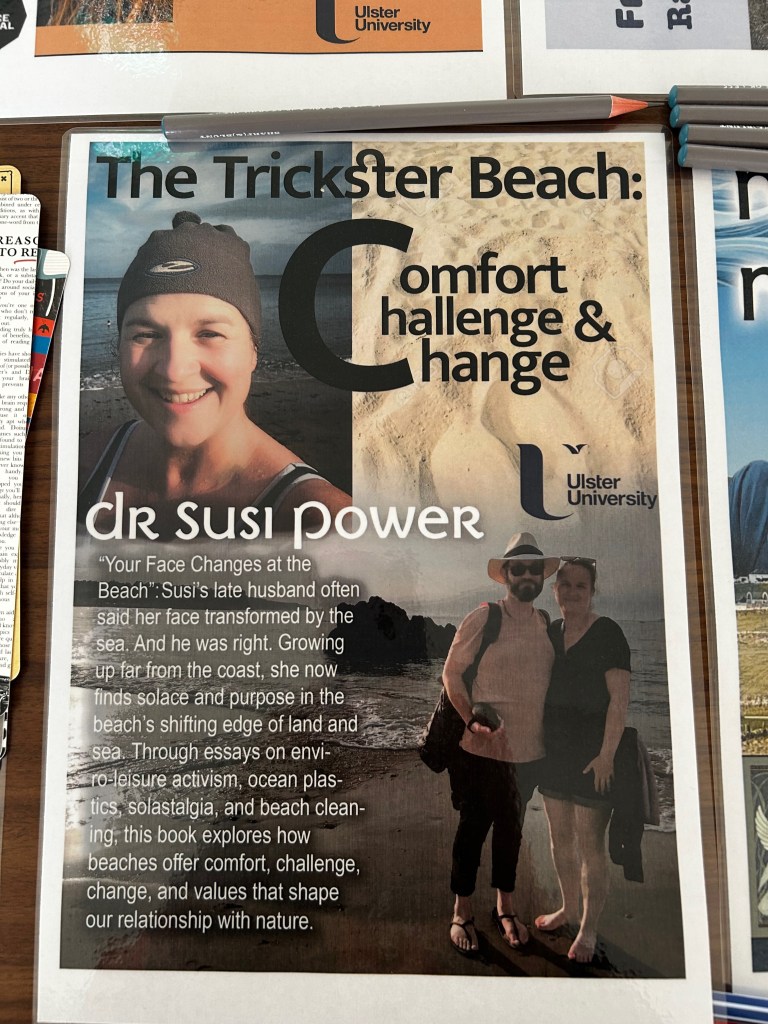
My Human Book: The Trickster Beach
When I was invited to be a Human Book, my immediate response was: sign me up. My second thought came just as quickly: It has to be a book about the beach. There is no landscape more meaningful to me than the liminal space where land meets sea. This shifting edge that has shaped my personal life, my research, and my sense of self. From this came my Human Book title and blurb:
The Trickster Beach: Comfort, Challenge, and Change
“Your face changes at the beach.” My late husband used to say that, and he was right. Although I grew up far from the coast, the beach has become a place of solace, purpose, and renewal for me. Through essays on enviro‑leisure activism, ocean plastics, solastalgia, and beach cleaning, my Human Book explores how beaches offer comfort, pose challenges, and inspire change in the ways we relate to our natural world.
Conversations Across the Library Shelves
Readers chose from specially designed book covers, selecting the stories they wished to “borrow.” What unfolded next was a morning filled with attentive listening, generosity, and care. Many readers asked about beach cleaning, a hobby that has also become a vital part of my research. We spoke about the overwhelming challenge of ocean plastics and the psychology of beach cleaning as a form of enviro-leisure activism. Some conversations were deeply personal. I shared how the beach sustained me during my husband’s illness and after he passed. The rhythmic practice of beach cleaning brought quiet solace. The cold-water shock of sea swimming brought moments of aliveness when life felt unbearably heavy.
Readers responded with their own stories of loss, resilience, and the healing pull of the shoreline. “This beach is my anchor. My daughter loved it here,” one reader reflected. Change also found its way into our discussions; both the change the beach itself constantly undergoes and the change we can create. I spoke about our Beach Clean 2.0 project and the potential for circular waste management. These conversations sparked further reflections on marine pollution, reminding many of David Attenborough’s words: “The ocean is the lifeblood of our home.”
Reflections on a Human Library
The Human Library event was extraordinary in countless ways. Rathlin residents and Ulster University researchers came together to share stories of perseverance, adventure, resilience, and sustainability. Powerful moments of understanding emerged. Moments that will stay with both “books” and “readers” long after the event has finished. In this shared space, vulnerability and bravery sat side by side. The experience was a reminder that knowledge exchange doesn’t have to be a series of PowerPoint slides and formal presentations. It can be dynamic, relational, and deeply human.
That morning on Rathlin Island, it truly was.
 Susann Power
You must be logged in to post a comment.