The 2026 Tourism and Hospitality Research in Ireland Conference (THRIC) served as a timely reminder of the collective agency embedded within our academic and professional community. Since its inaugural gathering in Portrush in 2005 and following a Covid-19-induced hiatus, its revitalisation at MTU Dingle, Co. Kerry in 2024, THRIC has evolved into far more than an annual academic meeting. Now in its 16th iteration, hosted generously at TU Dublin and with its next chapter already scheduled for Ulster University in 2028, it stands as a shared space where difficult questions, emerging challenges, and hopeful futures intersect.
The conference’s emblem, Colla, the hazel tree, symbolises wisdom, deep roots, and bold futures; an apt metaphor for a field navigating complexity while striving for transformation. Throughout the event, participants were invited to identify one concrete action they would carry forward. This blog reflects on the themes that might shape such choices. Opening the conference, Dr Deirdre Lillis, President of TU Dublin, situated attendees within the layered history of the Grangegorman campus, a site that has transitioned from prison, hospital, and mental asylum to a vibrant hub for learning and innovation. This narrative of transformation mirrors the trajectory of the tourism and hospitality sector itself: Ireland’s largest indigenous employer and a cornerstone of the island’s shared social and economic future.
Academic Agency in Uncertain Times: Keynote Reflections
The keynote address was delivered by Prof Nigel Morgan, Professor of Social Sustainability at Manchester Metropolitan University, and offered a compelling provocation titled “Shaping Tomorrow: Academic Agency in Uncertain Times.” His analysis captured the turbulence that increasingly shapes tourism, higher education, and broader social life:
- The relentless pace of uneven, uncertain change
- The narrowing effect of performance metrics on academic ambition
- Escalating societal anti‑intellectual sentiment
- Tourism’s moral ambivalence, caught between growth imperatives and environmental guilt
- An industry approaching a tipping point, seeking breathing space rather than expansion
Nigel urged a shift in orientation: from viewing change as something that happens to us, to recognising our role as active agents capable of shaping futures. He emphasised that academic influence often resides not in grand gestures but in the understated, ongoing practices that define scholarly life:
- Curriculum as a form of world‑building
- Teaching as long‑term policy infrastructure
- Research that broadens our moral and imaginative horizons
Hospitality, he argued, is inherently political. It is a moral practice rooted in welcome, inclusion, precarity, and the specificity of place. Conferences like THRIC matter because they can realign narratives and strengthen a collective sense of agency. As he reminded us, “The future of our field is not inevitable.” It is something continuously co‑created.
Mapping the Field: Research Themes at THRIC 2026
After I have reviewed the Conference Programme and Book of Abstracts, I summarise the conference content into thirteen interconnected themes that together reflect the current research directions shaping tourism, hospitality, and sustainable development. Key areas included:
- Visitor experience, authenticity, and value co‑creation, influenced by personal values, stewardship, and evolving perceptions of sustainability and luxury.
- Regenerative and circular tourism, with growing interest in policy frameworks, community engagement, and socio‑ecological renewal.
- Micro, small, and community‑based tourism, encompassing governance, digital transformation, inclusive development, and capacity building.
- Workforce‑focused research, addressing identity, wellbeing, occupational stigma, and evolving motivations in hospitality work.
- Digital transformation, including RAISA technologies, chatbots, smart destinations, and the integration of AI in tourism education.
- Pedagogical innovation, particularly around embedding Education for Sustainable Development (ESD), authentic assessment design, and enhancing digital and sustainability competencies.
- Environmental performance, spanning hotel revenue recovery, refugee accommodation, waste management, and emissions metrics.
Additional themes such as experiential marketing, food and place‑based tourism, EU policy alignment, revenue management, and heritage mediation highlight the field’s expanding intellectual scope. Collectively, these strands reflect a research agenda strongly oriented toward sustainability, digitalisation, resilience, and improved experiences for both visitors and workers.
Insights from the Abstract Analysis
As a member of the THRIC 2026 Academic Board, I also conducted an analysis of sixty‑seven anonymised abstracts submitted to THRIC 2026 highlighting recurring patterns in thematic engagement, terminology, and methodological orientation.
Thematic Engagement:
- Fifty‑five abstracts engaged with at least one conference theme, with seven selecting multiple themes.
- The most frequently selected themes emphasised change and future-oriented thinking, particularly “New visions, paradigms and values shaping change” (14 submissions) and “Navigating and managing change in THEL in turbulent times” (10 submissions).
- No submissions aligned with “Ethical values and practices in THEL” or “Navigating an aging society”, signalling notable gaps.
Keyword Usage:
- From sixty‑one abstracts providing keywords, 223 unique keywords were identified and the categorised thematically
- The most common categories were Sector‑specific (38), Education, Pedagogy, Training (36), and Principles, Concepts, Paradigms (35).
- When “tourism” and “hospitality” were excluded, Workforce, HR, Staff rose sharply with 33 occurrences.
- Categories with the fewest entries included AI, Digital, SMART (11), Environment, Climate (8), and Geographies (8).
Methodologies:
- Sixty‑four abstracts referenced a methodology.
- Qualitative approaches dominated (132 occurrences), followed by quantitative methods (59), literature‑review/conceptual work (45), and document/archival research (35).
- The prevalence of exploratory and literature‑based contributions suggests a vibrant community of early career and PhD researchers presenting emerging research.
Overall, the abstract analysis demonstrates a field deeply engaged with questions of transformation, pedagogy, workforce dynamics, and conceptual development, with a clear methodological leaning toward qualitative inquiry.
Building Stronger Communities: Establishing Special Interest Groups (SIGs)
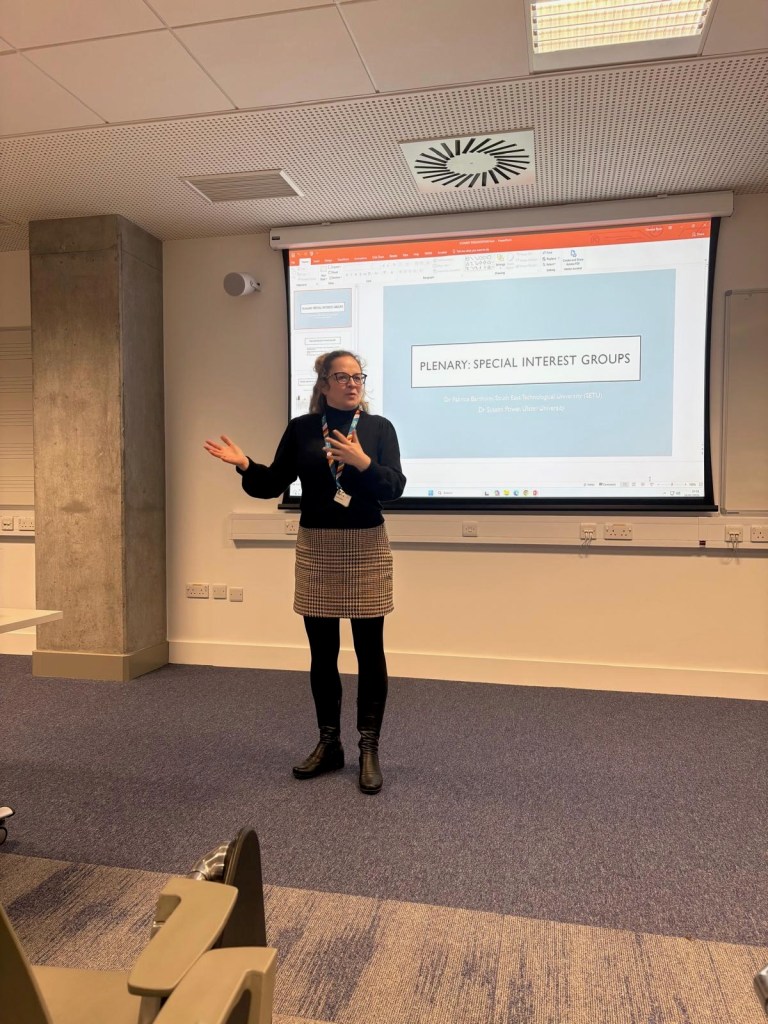
As we enter a new dawn for THRIC on the island of Ireland, the THRIC Board has decided to establish Special Interest Groups to facilitate scholarly exchange between the bi-annual conference. Dr Fabrice Bartholin (SETU) and I conducted a SIG interest survey, indicating that 92% of all surveyed researchers favoured the establishment of SIGs within the THRIC Community.
A combined statement of goals reads as follows:
THRIC SIGs aim to:
- Strengthening cross‑institutional collaboration through joint funding applications, shared research agendas, and coordinated efforts to increase both national and international research impact.
- Building communities of practice where like‑minded researchers can share ideas and co‑develop practical solutions to real‑world issues.
- Bridging academia, industry, and policy makers, advancing knowledge exchange and practical impact.
- Facilitating networking and collaboration, including writing retreats, reading groups, shared resources, and preparation of larger funded research bids.
- Expanding scholarship in tourism knowledge management, especially in areas such as 1) work, workforce and fair work in THEL; 2) technology, digitalisation and AI; 3) entrepreneurship, enterprise and innovation in THEL; 4) teaching, learning and education in THEL; 5) sustainability, regeneration and circular economy; and 6) marketing, consumer and visitor experience
One Action to Carry Forward
Across plenaries, panels, and corridors, a consistent message emerged: our field is shaped not only by major structural forces but by the everyday decisions we make as educators, researchers, collaborators, and community partners. Whether through embedding ESD, experimenting with transformative pedagogies, involving communities in policy processes, rethinking governance models, or challenging dominant narratives, the invitation remains:
Choose one action. Begin there. Join us on our THRIC journey.
From deep roots, bold futures continue to grow.
Author: Dr Susann Power, s.power@ulster.ac.uk
With special thanks to Dr Fabrice Bartholin, Lecturer in Hospitality Management and Tourism, South East Technological University, Ireland; Prof Nigel Morgan, Professor of Social Sustainability, Manchester Metropolitan University, UK; Dr Ziene Mottiar, THRIC 2026 Chair and Senior Lecturer at TU Dublin, Ireland; and the entire Board of THRIC.


You must be logged in to post a comment.