To cite the original article:
Power, S. (2022). Enjoying your beach and cleaning it too: a Grounded Theory Ethnography of enviro‑leisure activism. Journal of Sustainable Tourism, 30(6), 1438–1457. https://doi.org/10.1080/09669582.2021.1953037
Last night was something special.
We were invited by the Gillian McCollum, Mayor of Ards and North Down Borough Council, to Bangor City Hall to celebrate 10 years of the Beach Cleaners Ards and North Down, which is a community of over 3,000 dedicated beach cleaning volunteers. Being in that room, surrounded by people who genuinely care about the coastline we all love, was both humbling and inspiring. I’ve been part of this group since April 2018. I joined as a way not only to help conserve our coastline, but also to enjoy it more deeply. Over the past decade, this remarkable group has organised 216 clean-ups across 185 km of coastline, including Areas of Special Scientific Interest and the Strangford Lough Area of Outstanding Natural Beauty. Together, we’ve removed 12 cubic tonnes of litter, which is the equivalent of an entire dump truck, and hundreds of thousands of individual pieces that no longer threaten marine and coastal life. It was a powerful reminder of what collective action can achieve.
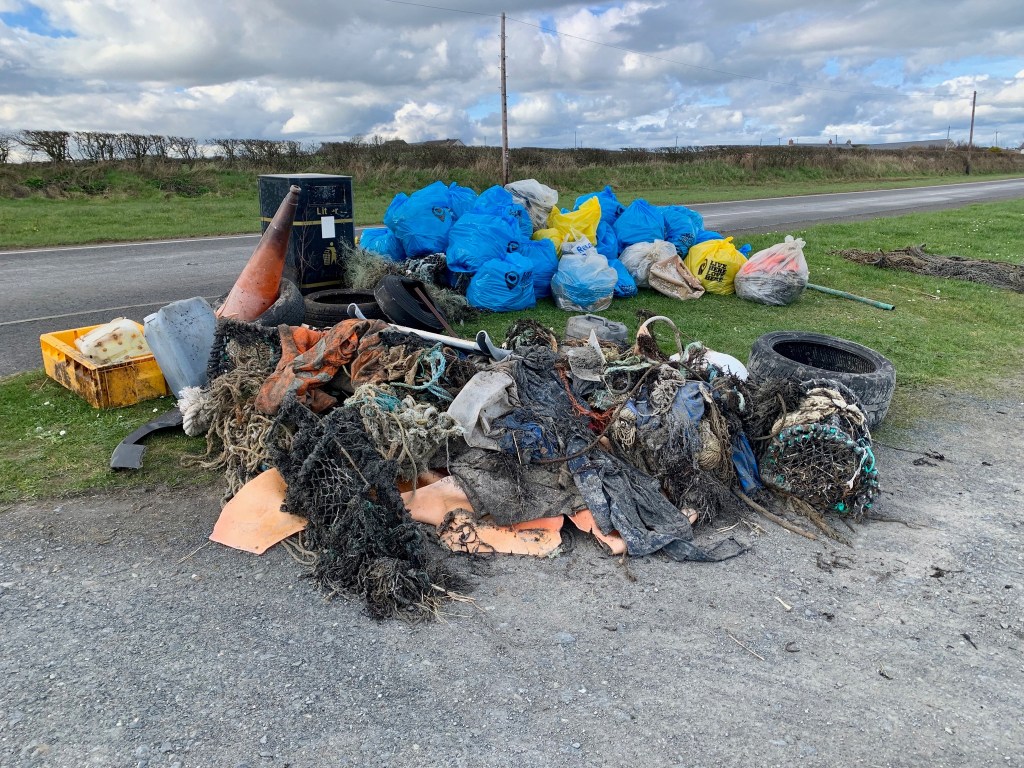
Why Beach Cleaning Matters
Marine litter remains a persistent problem, which has barely been improved over the last 10 years. In 2020, Keep Northern Ireland Beautiful counted 508 pieces of litter per 100 metres of coastline. In 2026, that figure still sits at around 500 pieces per 100 metres. That’s roughly five pieces of litter for every step you take.
This is what researchers call a “wicked problem” (Rittel and Webber, 1973). Wicked problems are complex, ongoing, and without a simple solution. While many people assume litter washes in from the sea, research shows that between roughly half and four-fifths of it comes from human activity on land. The impacts go far beyond environmental harm:
- Up to 97% of a beach’s economic value can be lost due to pollution (Balance et al., 2000)
- Tourists may reduce their stay by up to 60% on littered beaches (Esparon et al., 2015)
- Visitor satisfaction drops significantly
- Heavily polluted beaches can see up to an 85% decline in visitation (Krelling et al., 2017)
- Local residents’ perceived quality of life can fall by as much as 90% (Stoeckl et al., 2014)
These staggering figures are deeply concerning. Against this backdrop, my research set out to understand two key questions:
- How can we better understand beach cleaning as a behaviour?
- What does this mean for tourism and coastal recreation?
Inside the World of Beach Cleaners
Before starting the research, I was already a beach clean volunteer. But this time, I wanted to go deeper. Over 18 months, I immersed myself fully in the beach cleaning community by participating in as many clean-ups as possible, observing behaviours, speaking with volunteers, and recording detailed field notes. Ethically approved and grounded in ethnographic methods, the study explored beach cleaning through four lenses:
- Activism: behaviour driven by a cause
- Casual volunteering: participation motivated partly by personal benefit
- Serious leisure: activities pursued with commitment and identity
- Environmental ethics: how we understand our relationship with nature
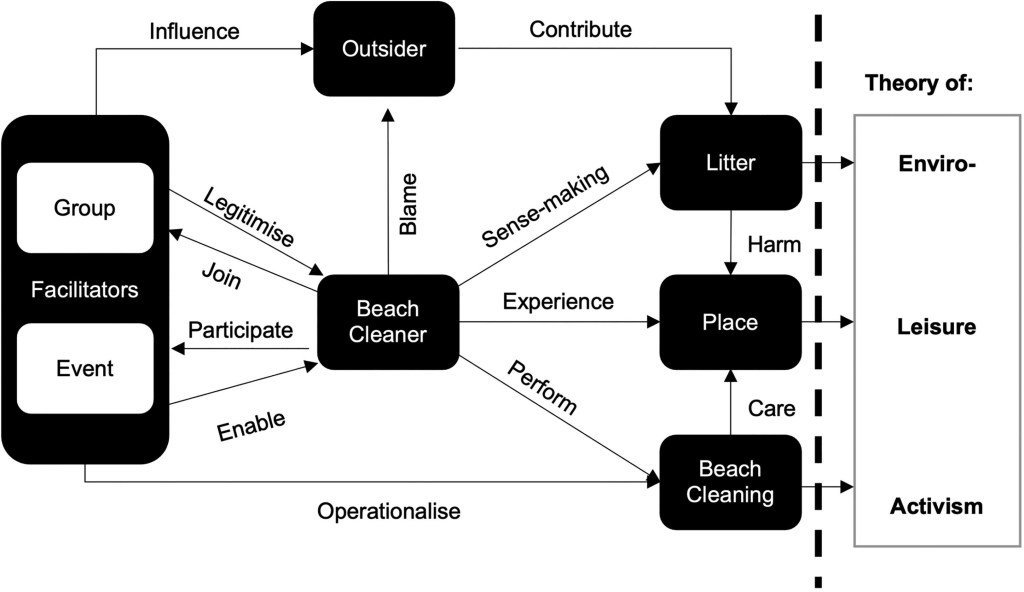
The result was what I called a Grounded Theory of Enviro‑Leisure Activism; a way of understanding beach cleaning as both environmental action and a meaningful leisure activity. The figure below shows a Concept-Indicator-Map of Enviro-Leisure Activism.
What I Found: Key Insights
While the full study goes into depth, several key insights stand out:
- Beach cleaners are not always local: Many participants are visitors or day-trippers. This opens opportunities to engage tourists and recreational users, not just residents.
- It’s not just cleaning. It’s “litter hunting”: There is often a surprising sense of competition and achievement. People actively search for unusual or large items, adding a playful, game-like element.
- Storytelling matters: Volunteers frequently share stories about what they find, what they experience, and how they feel. This helps process the scale of the problem and builds community.
- Place attachment is key: People clean beaches because they love them. Emotional connection to place is a powerful motivator.
- It’s a close-knit community: Beach cleaners often form strong identities and bonds; a kind of “tribe.” While welcoming, these groups can be somewhat inward-facing, which makes thoughtful collaboration important.
- Groups and events both matter: Groups create belonging and continuity, while events provide visibility, shared experiences, and momentum
What Does This Mean in Practice?
One of the most important takeaways is this:
Beach cleaning is not just environmentalism. It is also leisure, social connection, and personal fulfilment.
This has several practical implications:
- Promote beach cleaning as a leisure activity, especially for families and visitors
- Improve communication between groups, for example through digital platforms
- Support organisers with practical challenges like insurance and risk assessments
- Engage volunteers in decision-making, through forums, town halls, or even a dedicated “Litter Summit”
At present, beach cleaners often lack a formal voice despite their experience and commitment. That needs to change. Tourism planners and policymakers should recognise that beach cleaning is:
- Performative (it involves visible, active participation)
- Emotional (people deeply care about places)
- Social (it builds communities)
Campaigns should move beyond purely environmental messaging to embrace leisure, wellbeing, and community engagement.
Looking Ahead
As long as there is litter on our beaches, there will be people willing to pick it up. And that’s something worth celebrating. The Beach Cleaners Ards and North Down are proof that collective, community-driven action matters. We are growing in numbers, and even more so in commitment. If you’d like to be part of the movement or simply join the conversation you know where to find us. Because sometimes, the best way to enjoy a place…is to take care of it.
References
Ballance, A., Ryan, P. G., & Turpie, J. K. (2000). How much is a clean beach worth? The impact of litter on beach users in the cape peninsula, South Africa. South African Journal of Science, 96(5), 210–230.
Esparon, M., Stoeckl, N., Farr, M., & Larson, S. (2015). The significance of environmental values for destination competitiveness and sustainable tourism strategy making: Insights from Australia’s great barrier reef world heritage area. Journal of Sustainable Tourism, 23(5), 706–725.
KNIB. (2020). Marine litter report. Keep Northern Ireland Beautiful.
KNIB. (2026). Marine litter report. Keep Northern Ireland Beautiful.
Krelling, A. P., Williams, A. T., & Turra, A. (2017). Differences in perception and reaction of tourist groups to beach marine debris that can influence a loss of tourism revenue in coastal areas. Marine Policy, 85, 87–99.
Rittel, H. W., & Webber, M. M. (1973). Dilemmas in a general theory of planning. Policy sciences, 4(2), 155-169.
Stoeckl, N., Farr, M., Jarvis, D., Larson, S., Esparon, M., Sakata, H., … Constanza, B. (2014). The great barrier reef world heritage area: Its ‘value’ to residents and tourists project 10-2 socioeconomic systems and reef resilience. Final report to the national environmental research program. Reef and Rainforest Research Centre Limited.


You must be logged in to post a comment.