I enjoy going back to my academic research and translating it into something more accessible. In this post, I revisit a paper I co-authored with Prof MariaLaura Di Domenico and Prof Graham Miller on a fascinating topic: how entrepreneurs in sustainable tourism deal with risk.
For those interested, the original academic article is:
Power, S., Di Domenico, M., & Miller, G. (2020). Risk types and coping mechanisms for ethical tourism entrepreneurs: A new conceptual framework. Journal of Travel Research, 59(6), 1091–1104. https://doi.org/10.1177/0047287519874126
Starting a business is always a gamble. Many entrepreneurs face uncertainty around income, job security, and even the survival of their company. Much has been written about risk and entrepreneurship. Attitude to risk is a key entrepreneurial personality trait. But what about tourism entrepreneurship? It is an industry that is teeming with small and independent ventures. It is dependent on seasonality, vulnerable to global shocks like the recent Covid-19 pandemic, caught in the space between private and public ownership and nestled within a multi-stakeholder universe. While researchers agree that risk is central to entrepreneurship – and indeed tourism – we know very little about the types of risks faced by tourism entrepreneurs, especially those who try to do business ethically and sustainably. This is where our research comes in.
Who Are “Ethical Tourism Entrepreneurs”?
Our research focuses on so called ‘ethical tourism entrepreneurs’. These individuals are business owners who aim to make a profit and contribute positively to society and the environment. They don’t reject profit, but they don’t chase it at any cost either. Principle outweighs profit maximisation.
They are different from:
- Social entrepreneurs, whose primary mission is social rather than economic, and
- Lifestyle entrepreneurs, who run businesses mainly to support a preferred way of life.
Ethical tourism entrepreneurs sit somewhere in between. They want viable businesses, but also meaningful impact and are often driven by lifestyle and mindsets that support ethical business conduct.
What We Found: Risks Come in Pairs (with Coping Skills)
Our research revealed something important:
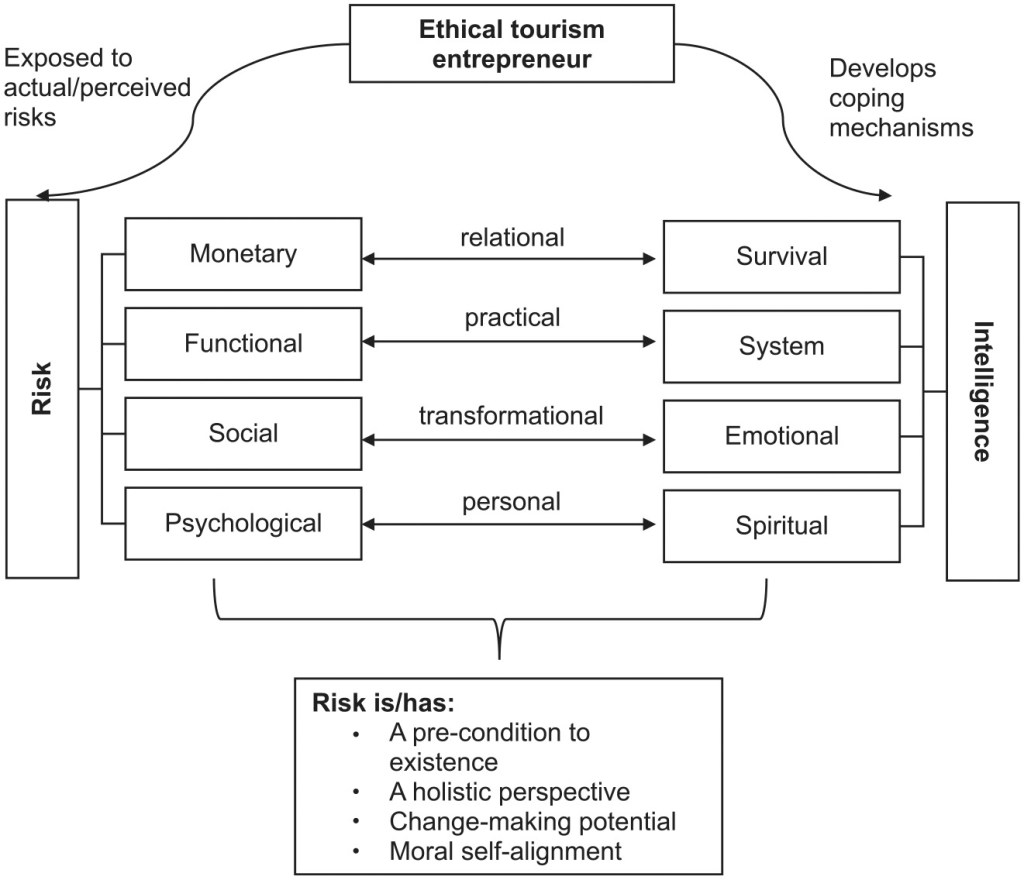
Entrepreneurs don’t just face risks, they develop specific ways of coping with each type. In fact, we found four key types of risk, each paired with a particular kind of “intelligence” that helps entrepreneurs manage them. The diagram below provides an overview of the risk-types and coping mechanisms and their function.
1. Monetary Risk → Survival Intelligence
The challenge
Getting funding is difficult for most entrepreneurs, but it’s even harder when your business is based on sustainability. Investors often want quick returns. Ethical tourism, however, tends to focus on long-term outcomes like environmental protection or community development, which don’t always pay off immediately.
As a result many entrepreneurs rely on personal savings, growth can be slower and more uncertain, and they possess a strong awareness of financial risk.
How they cope
What helps is something we call survival intelligence. It’s financial savviness paired with building relationships and thinking long-term. These entrepreneurs focus on mutual benefit with communities and partners, balance profit with purpose, and see business survival as necessary for creating wider impact. In other words, staying afloat isn’t selfish. It’s essential if they want to do good. The relationship between financial risk and survival intelligence is relational. It is a coping mechanism based on relationships with other stakeholders, with a view to gain mutual, long-term viability.
2. Functional Risk → Systems Intelligence
The challenge
Running an ethical tourism business is complex, especially across different locations. Entrepreneurs face constant trade-offs, such as global pressures vs local realities, managing operations from afar, balancing small size flexibility against large scale resource needs, and pivoting private control against shareholder expectations. There’s no perfect balance and operationally, there is a risk of losing control.
How they cope
They develop systems intelligence: the ability to see the bigger picture and connect multiple moving parts. This means adapting quickly to changing circumstances, finding practical, context-specific solutions and managing complexity without rigid structures. As one entrepreneur put it, you have to be like a “Swiss army knife”, versatile and ready for anything. Functional or operational risk and system intelligence are a practical pairing. System intelligence provides practical guidance on how to navigate functional uncertainty.
3. Social Risk → Emotional Intelligence
The challenge
Tourism is fundamentally about people: customers, employees, communities, and partners. But ethical tourism adds another layer as some stakeholders don’t understand the value of sustainability, making ethical practices can be harder to “sell”. Employees and customers may resist change and industry peers may even push back. And importantly, these entrepreneurs often refuse to compromise their values, even when it costs them business. Therein lies a social risk.
How they cope
They rely on emotional intelligence, which includes empathy and cultural sensitivity, listening and understanding different perspectives, building trust with communities, and communicating ethical values effectively. Emotional intelligence helps them gain credibility and, over time, influence people’s attitudes and behaviours. This is what makes this risk-intelligence pairing transformational in nature. In many ways, these entrepreneurs don’t just offer products, they help change how people think about travel.
4. Psychological Risk → Spiritual Intelligence
The challenge
Running a values-driven business can be emotionally demanding. Entrepreneurs spoke about feeling uncertain or naïve at the start of their venture, experiencing pressure and anxiety, struggling with lack of recognition, and feeling personally tied to their business identity. When your business reflects your values, failure feels deeply personal. Success becomes imperative.
How they cope
They develop what we call spiritual intelligence. This isn’t about religion, it’s about having a clear sense of purpose. It helps entrepreneurs to align their business with their personal values, make decisions in uncertain situations, stay motivated despite challenges, and see their work as part of a bigger mission. At the same time, they still need support. Many highlighted the importance of building teams and networks because doing ethical business alone can feel isolating. Navigating psychological risk is deeply personal.
So What Does This All Mean?
Ethical tourism entrepreneurs are not just risk-takers, they are skilled navigators of complexity. They face higher financial barriers, greater operational challenges, more difficult stakeholder relationships, and stronger emotional and psychological pressures. Our research has shown that risk is inherent to the existence of ethical tourism entrepreneurs. They acquire a holistic perspective on risk, differentiating between financial, operational, social and psychological types. Yet they persist because they are equipped with:
- Survival intelligence
- Systems intelligence
- Emotional intelligence
- Spiritual intelligence
These capabilities are morally aligned and allow them to take risks that others might avoid and turn them into opportunities for long-term, positive impact. The intelligences are relational, practical, transformational and personal. They can affect change over time. Tourism has immense potential not just as an economic activity, but as a force for social and environmental change. Ethical tourism entrepreneurs sit at the heart of this potential. They show us that doing business differently is not easy, but it is possible.


You must be logged in to post a comment.