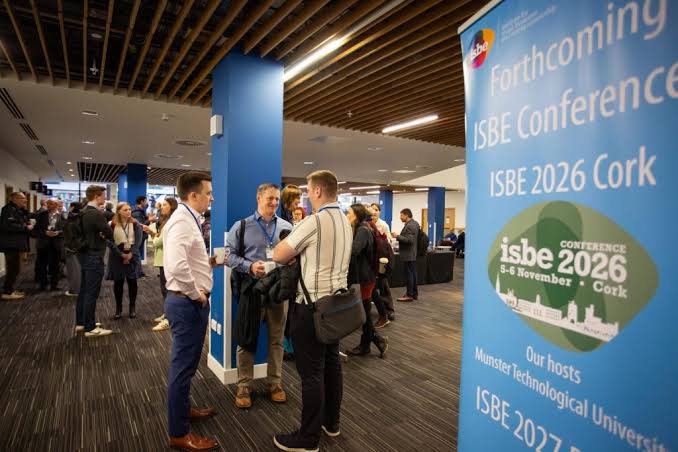
The Institute for Small Business and Entrepreneurship (ISBE) Conference 2026 was held in Cork on 5-6 November, marking the conference’s first visit to Ireland in 25 years and its inaugural appearance in Cork. The event was hosted by Munster Technological University and brought together approximately 270 delegates, presenting 185 research papers. Now in its 48th year, ISBE continues to attract both new scholars alongside long-standing members who have witnessed the evolution of entrepreneurship research over several decades. For me it was my second visit to ISBE – and not my last. It really is a wonderful conference and a fantastic academic community.
This year’s conference theme, “Resilient and Regenerative Entrepreneurship: Navigating Climate Challenge and Circular Economy”, reflected the growing emphasis on entrepreneurship’s role in addressing pressing environmental and societal challenges. The keynote address was delivered by Professor Luke Pittaway, ISBE Fellow and Copeland Professor of Entrepreneurship at Ohio University. Entitled “Curious Search in Regenerative Entrepreneurship Education”, the keynote offered a thought-provoking exploration of curiosity as a critical, yet often overlooked, entrepreneurial competence.
Professor Pittaway argued that curiosity remains one of the distinctly human cognitive capacities that artificial intelligence cannot easily replicate. While AI is increasingly capable of performing a range of cognitive tasks, curiosity remains fundamental to human creativity and entrepreneurial action. He situated this discussion within the broader entrepreneurship competencies movement that gained prominence during the 2010s, suggesting that the field now finds itself on the threshold of a new paradigm shift: the sustainability transition.
Importantly, he challenged delegates to consider which sustainability paradigm should guide entrepreneurial thinking and practice. Potential frameworks include the United Nations Sustainable Development Goals, Circular Economy models, the Blue and Green Economy, Doughnut Economics, boundary-spanning approaches, post-growth economics, and, perhaps most significantly in the context of this conference, the emerging regenerative sustainability paradigm. Though, I’ve added the Green and the post-growth economies.
Central to his argument was the need to cultivate regenerative mindsets, regenerative principles, and regenerative practices through entrepreneurship education. Rather than focusing solely on mitigating negative impacts, regenerative approaches seek to restore, renew and enhance ecological and social systems.
Drawing on his recent work (see Hsieh and Pittaway, 2025), Professor Pittaway highlighted how curiosity enables entrepreneurs to recognise forms of environmental and social degradation that others may overlook, thereby broadening the definition of opportunity. Curiosity also encourages place-based experimentation, deeper engagement with local contexts, and long-term systems thinking, all of which align closely with regenerative approaches to sustainability. In this sense, curiosity may be one of the most underappreciated foundations of entrepreneurial success.
Inspired by this call for curiosity, I wanted to explore how these ideas were reflected in the conference programme. I therefore reviewed the papers focused specifically on ‘resilient and regenerative entrepreneurship’ and ‘social and sustainable entrepreneurship’ as these are the two tracks that are most closely aligned to the conference and keynote theme. Across the 22 papers examined, several noteworthy themes emerged.
1. Regenerative Entrepreneurship as an Emerging Paradigm
A dominant theme is the conceptual development of regenerative entrepreneurship, which extends beyond minimising harm to actively restoring social and ecological systems. Papers explore the theoretical foundations of regeneration, questioning conventional growth-oriented entrepreneurial models and proposing alternative approaches centred on renewal, reciprocity, and ecosystem health.
Key insight: Sustainability is increasingly viewed as insufficient; regeneration represents a more transformative goal focused on creating net-positive environmental and social outcomes.
2. Circular Economy and Ecosystem Transformation
A second major theme relates to the circular economy and systemic innovation. Papers examine how entrepreneurs, SMEs, communities, and policy actors can contribute to circular transitions through innovation ecosystems, social collaboration, and scaling mechanisms. Topics include barriers to circular economy adoption, trust and legitimacy within circular innovation systems, and pathways towards a just circular economy.
Key insight: Achieving circularity requires collaboration across networks of actors rather than isolated firm-level initiatives.
3. Legitimacy, Trust, and Organisational Mechanisms
Several papers focus on how sustainability-oriented ventures gain legitimacy and maintain credibility. Topics such as green claims, organisational mechanisms for balancing purpose, planet and profit, sustainability-oriented legitimation, and trust within circular ecosystems highlight the governance challenges faced by entrepreneurs pursuing environmental missions.
Key insight: Success increasingly depends on demonstrating authentic sustainability performance and securing stakeholder trust rather than relying on sustainability rhetoric alone.
4. Resilience and Adaptive Capacity
Resilience emerges as another core theme, explored at both individual and organisational levels. Papers discuss business resilience measurement, resilience capabilities within social enterprises, entrepreneurial wellbeing, and opportunity filtering processes that help organisations adapt to uncertainty.
Key insight: Resilience is viewed not just as survival but as the capacity to learn, adapt, and transform in response to social, environmental, and economic disruption.
5. Social Entrepreneurship and Community-Based Innovation
The social and sustainable entrepreneurship stream highlights entrepreneurship as a mechanism for addressing societal challenges. Studies examine social bricolage, citizen-centric entrepreneurship, entrepreneurship in the social economy, and the role of virtues and moral values in entrepreneurial action.
Key insight: Social impact increasingly derives from community engagement, resourcefulness, and participatory approaches rather than purely market-based solutions.
6. Entrepreneurship for Public Value and Wicked Problems
Several contributions frame entrepreneurship as a tool for addressing complex societal and environmental issues. Papers on public value creation, sustainability challenges, and social enterprise suggest that entrepreneurs are becoming key actors in tackling “wicked problems” that cannot be solved by governments or markets alone.
Key insight: Entrepreneurship is increasingly understood as a societal change process rather than solely an economic activity.
7. Ethics, Wellbeing, and Moral Purpose
A growing emphasis on ethics is evident across both tracks. Topics include virtues, moral ecology, emancipation, CSR, entrepreneur wellbeing, and social responsibility. These papers move beyond economic performance to consider human flourishing, moral legitimacy, and quality of life.
Key insight: Entrepreneurial success is being redefined to include social justice, wellbeing, and ethical responsibility alongside economic outcomes.
8. Sector-Specific Sustainability Transitions
Several studies apply these ideas within specific contexts including tourism, football, social care, community enterprises, and finance. These sectoral studies demonstrate how sustainability and regeneration challenges vary according to institutional and cultural contexts.
Key insight: While sustainability principles may be universal, implementation is highly context-dependent and shaped by industry-specific pressures and opportunities.
Overall Synthesis
Across both tracks, the literature suggests a shift from “sustainable entrepreneurship” toward “regenerative entrepreneurship.” Rather than focusing primarily on reducing negative impacts, scholars are increasingly examining how entrepreneurs can foster ecological restoration, social wellbeing, resilience, public value, and systemic transformation. Three overarching priorities dominate the agenda:
- Building regenerative and circular economic systems.
- Developing resilient organisations and entrepreneurs capable of navigating grand sustainability challenges.
- Creating social and public value through ethically grounded entrepreneurial action.
Together, these papers portray entrepreneurship as a critical mechanism for advancing sustainability transitions and addressing complex societal challenges through collaborative, ecosystem-based approaches.
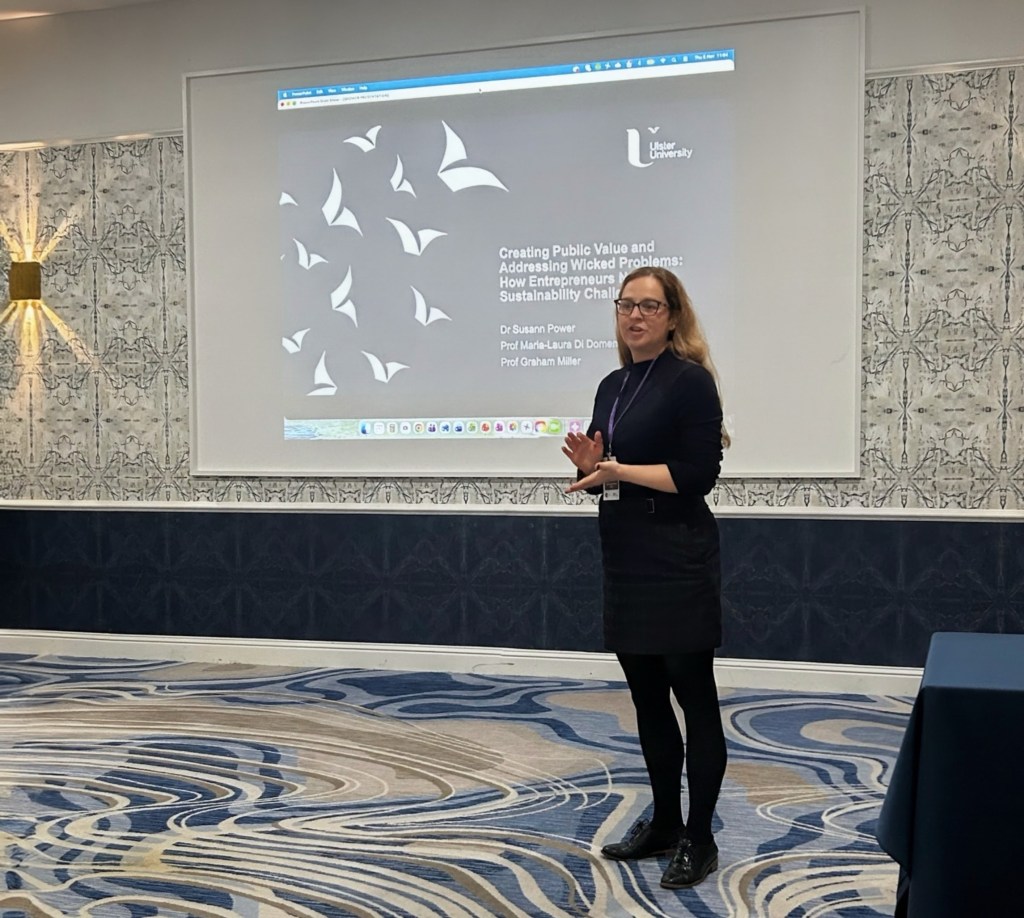
I am looking forward to ISBE 2027, which incidentally will be hosted at my home university – Ulster University in Belfast, Northern Ireland. I can’t wait to see how the resilient, regenerative, social and sustainable entrepreneurship tracks develop and this field of entrepreneurship scholarship grows. I did of course also present my own work – see pic below.


You must be logged in to post a comment.