How do we prepare future tourism and hospitality professionals to navigate a world defined by complexity, contradiction, and competing sustainability demands? As I was contemplating this question, I set out to develop an Education for Sustainable Development (ESD) initiative that is doing exactly that by embedding my own research, active learning, and paradox thinking directly into the curriculum.
Advance HE, the UK’s Higher Education Authority, defines Education for Sustainable development as “formal and informal learning opportunities which enable all students to develop the knowledge, skills, attitudes and values required to contribute to a sustainable future.” (Advance HE 2026, online). Similarly focussed on ESD, the Irish Higher Education Authority has created a an ESD spotlight series, where I was able to publish my pedagogy case study. (HEA 2025, online)
My ESD case study is grounded in on of our recently published original research papers “A longitudinal analysis of judgment approaches to sustainability paradoxes” (Power et al. 2024), which explores how industry executives make sense of sustainability dilemmas in tourism. Our study identifies three enduring paradoxes shaping contemporary practice:
- The Flying Dilemma (SDG13): Can tourism ever truly be sustainable if flying remains central to global mobility?
- The Experience Dilemma (SDG12): Does the push for exceptional customer experiences undermine sustainability goals?
- The Growth Dilemma (SDG8): If endless growth is unsustainable, how do we fairly enable people’s right to travel?
Rather than simply reading about these tensions, students experience them through an immersive, research-informed classroom activity that bridges theory, practice, and personal reflection.
From Research to Classroom: A Three‑Week Learning Journey
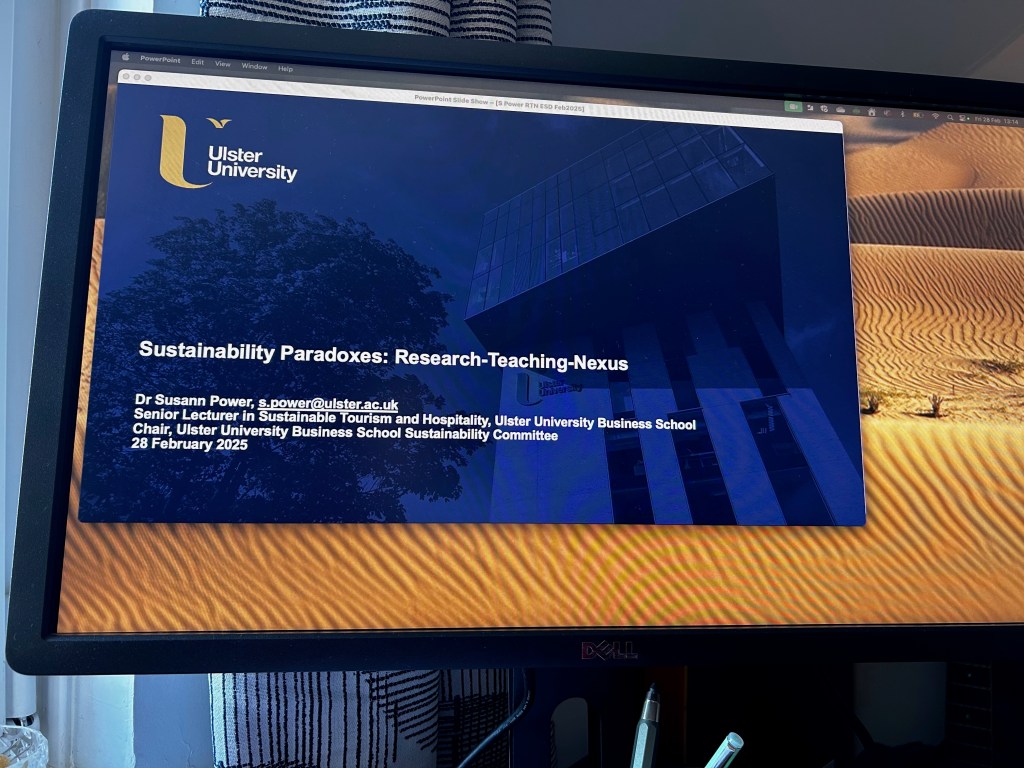
The initiative positions students as active partners in knowledge creation. After reading the original research article, students receive a short presentation from the lead author (myself), followed by anonymised excerpts from the research interviews. These data form the basis for a three‑week cycle of group discussions and position‑statement development.
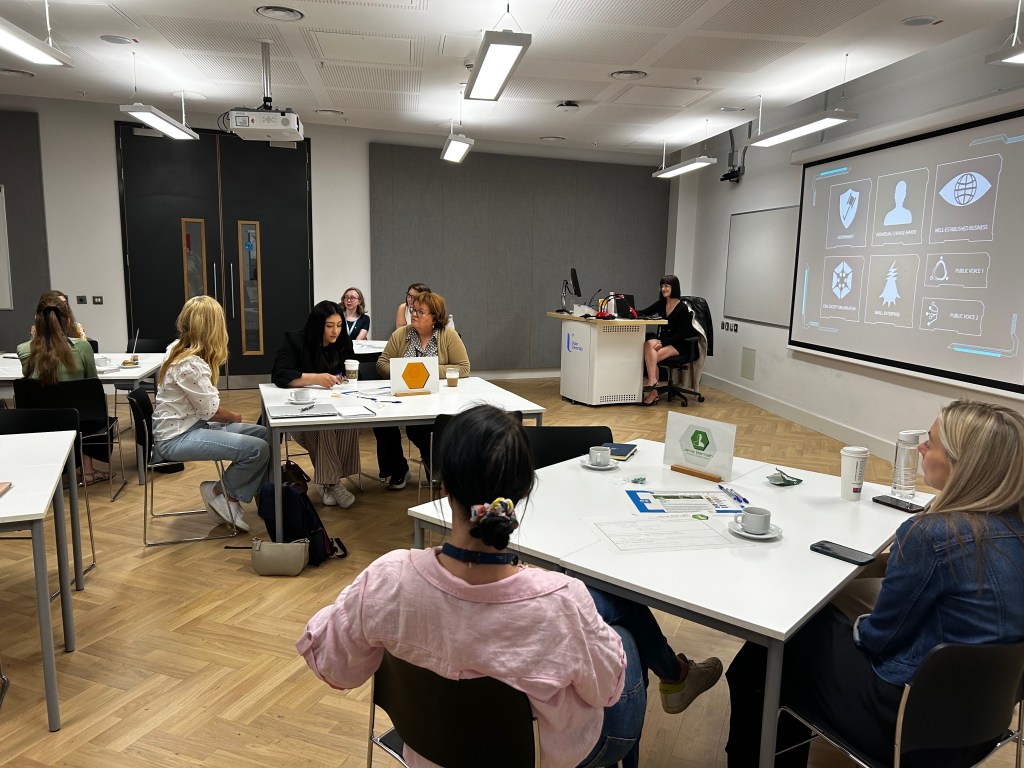
Across three themed sessions: Sustainable Hospitality Business, Hospitality and Net‑Zero, and Hospitality and Post‑Growth, students debate each paradox, craft concise three‑minute statements, and deliver them to their peers. This iterative activity builds confidence, critical insight, and collaborative competencies in a low‑stakes, supportive environment.
The format embodies Ballentine et al.’s (2022) and Healy et al.’s (2010) Research‑Teaching Nexus:
- Research‑led: Students listen to and learn from contemporary, published research.
- Research‑tutored: They explore paradoxes through discussion and questioning.
- Research‑based: They analyse interview data and generate their own interpretations.
- Research‑taught: Peer‑to‑peer presentations facilitate shared learning.
Knowing, Doing, Being: A Structured, Holistic Pedagogical Framework
The initiative is designed using Ulster University’s Integrated Curriculum Design Framework (ICDF), which emphasises Knowing, Doing, and Being (Barnett & Coate, 2004). Each dimension plays a critical role:
Knowing (Head): What students need to understand
- Key sustainability issues in tourism and hospitality
- How to engage with original research produced by their lecturer
- How sustainability paradoxes challenge conventional industry thinking
Doing (Hand): What students need to be able to perform
- Critical and paradox thinking through heuristic decision‑making
- Public speaking and persuasive communication
- Creative, evidence‑based problem‑solving
Being (Heart): Who students are becoming
- Ethical, reflective learners aware of their own cognitive biases
- Empathetic and socially responsible decision‑makers
- Professionals able to navigate complexity with integrity
The approach also aligns with UNESCO’s Key Competencies for Sustainability, incorporating systems thinking, collaboration, anticipatory thinking, and self-awareness. In addition, it reinforces key Ulster University Graduate Attributes, including responsible citizenship and innovative problem‑solving.
Skills and Competencies Developed and Assessed With Purpose
By participating in this research‑teaching nexus, students strengthen essential academic and professional competencies, including the ability to:
- Critically discuss sustainability challenges in tourism and hospitality
- Analyse and interpret authentic research data
- Propose innovative responses to sustainability paradoxes
- Reflect on personal biases and heuristic reasoning patterns
- Debate clearly, concisely, and persuasively in public forums
These are exactly the kinds of capabilities future industry leaders will need as the sector faces growing pressure to align growth, experience quality, and environmental responsibility.
The initiative feeds directly into a qualitative assessment in which students prepare a three‑minute position statement on a contemporary hospitality issue of their choice. The three seminar sessions provide safe practice opportunities with constructive feedback, ensuring students are supported before they deliver their assessed pitch.
This assessment design reinforces the research-teaching nexus:
- Research-tutored: exploring raw research data
- Research-based: synthesising data into defensible positions
- Research-taught: presenting arguments to peers
Impact and Why This Matters
The initiative has already demonstrated measurable impact. Since its introduction in AY2024/25, student performance on this assessment component has improved, and I have now adopted the approach within a postgraduate programme at Ulster University. Students report developing greater critical thinking, paradox awareness, compassion, and empathy, all of which are qualities essential for navigating sustainability challenges in an increasingly complex world.
Tourism and hospitality are industries defined by tensions: profit and planet, experience and ethics, growth and responsibility. By placing these paradoxes at the centre of learning, this initiative ensures students are not only knowledgeable but capable, reflective, and resilient. This research‑teaching nexus model demonstrates what meaningful ESD looks like: students learning with research, through research, and as emerging researchers themselves.
Further Information and References
The teaching case study (Open Access): https://hub.teachingandlearning.ie/education-for-sustainable-development/esd-spotlight-series/esd-case-studies/entry/10310/#entrya
The original research article (Open Access): https://www.sciencedirect.com/science/article/pii/S0261517723001590
The Irish Higher Education Authority’s ESD Spotlight Series: https://hub.teachingandlearning.ie/education-for-sustainable-development/esd-spotlight-series/
Advance HE (UK)’s Education for Sustainable Development webpages: https://www.advance-he.ac.uk/teaching-learning/education-sustainable-development-higher-education
Ulster University’s Integrated Curriculum Design Framework: https://www.ulster.ac.uk/learningenhancement/resources/icdf
Ballentine, M., Floyd, S., McChesney, I., Boyd, K., & Bond, RR. (2022, Apr 15). Research-Teaching Nexus Toolkit. https://doi.org/10.21251/m9qv-1e84
Barnett, R., & Coate, K. (2004). Engaging the curriculum. McGraw-Hill Education (UK).
Healey, M., Jordan, F., Pell, B., & Short, C. (2010). The research–teaching nexus: a case study of students’ awareness, experiences and perceptions of research. Innovations in Education and Teaching International, 47(2), 235-246. doi:10.1080/14703291003718968
UNESCO Key Competencies for Sustainability: https://www.unsdglearn.org/unesco-cross-cutting-and-specialized-sdg-competencies/
 Susann Power
You must be logged in to post a comment.